
Project Summary
Project Title: “Southeast Michigan Flood and Storm Damage Reduction General Investigation Study”
Massive floods like those of 2021 are becoming more frequent, and Southeast Michigan’s infrastructure wasn’t built for them. To protect homes, roads, and businesses, the U.S. Army Corps of Engineers, Great Lakes Water Authority, and University of Michigan are studying where flooding hits hardest—and how to prevent it.
The research team is using advanced modeling to simulate future storms, pinpoint vulnerable areas, and test both traditional infrastructure upgrades and nature-based solutions such as wetlands and green spaces. Their work will guide billions in future investments and help local communities secure federal funding for the most effective solutions.
Ultimately, the project aims to protect people and property across the region, building a blueprint for how Great Lakes cities can adapt to a wetter, more unpredictable future.
Southeast Michigan faces chronic and acute flooding challenges driven by severe rainfall events, aging infrastructure, rapid urban development, and changing climate conditions. The devastation caused by events such as the June 2021 “1,000-year” storm revealed gaps in existing stormwater systems and underscored the urgent need for holistic regional approaches to flood risk management. The Great Lakes Water Authority (GLWA), in partnership with the U.S. Army Corps of Engineers (USACE), initiated this General Investigation (GI) Study to systematically assess flood resilience and stormwater management options across Southeast Michigan. U-M is a formal team member. The project will integrate conventional (gray) infrastructure improvements with innovative nature-based solutions, aligning regional efforts and leveraging diverse stakeholder expertise to maximize future implementation capacity while addressing equity, environmental justice, and long-term sustainability.
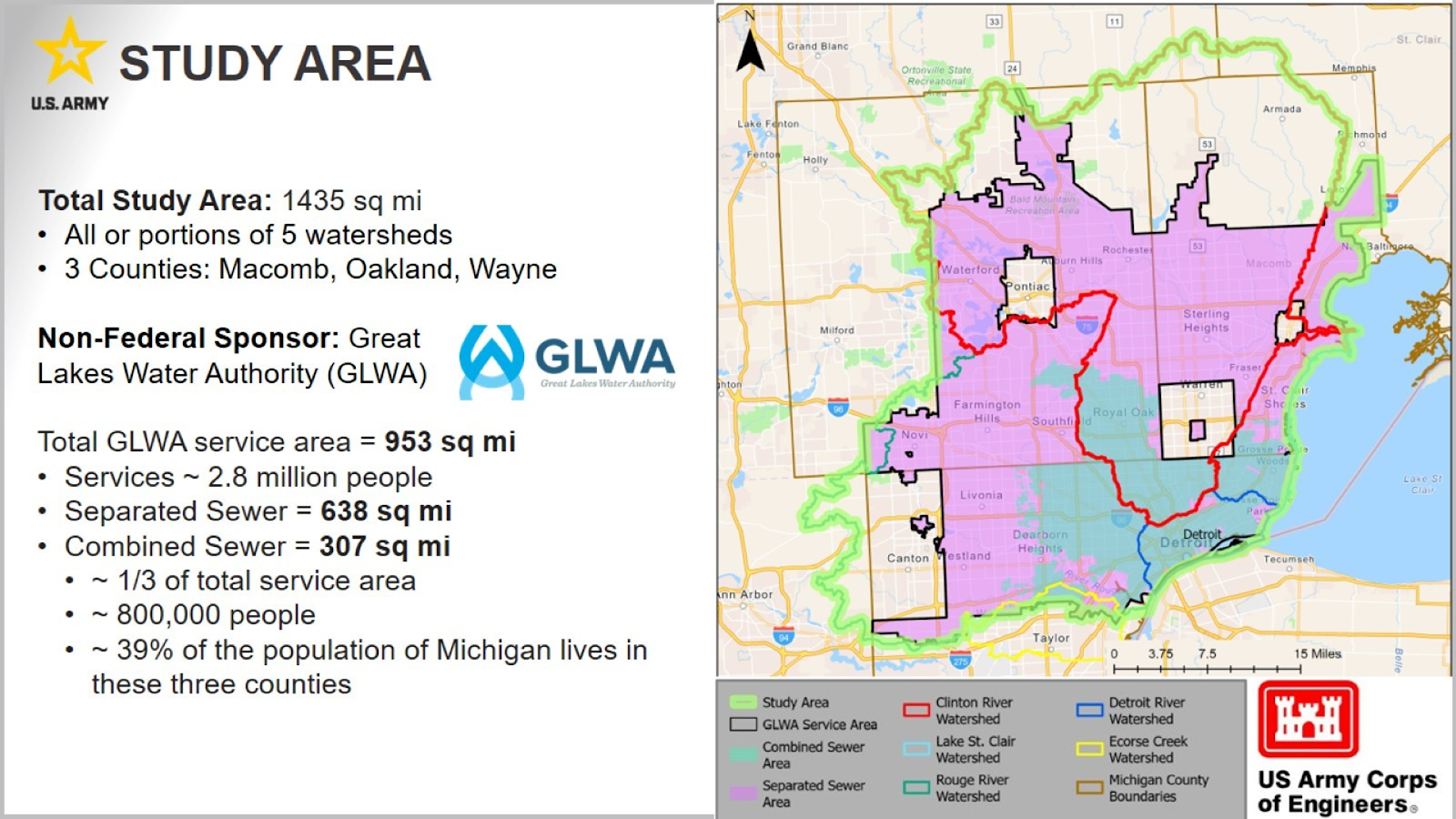
The primary objective of the project is to produce actionable strategies, alternatives, and a robust decision framework for reducing flood risk and stormwater impacts in Southeast Michigan. The approach is highly collaborative and interdisciplinary:
- Conduct comprehensive data collection, modeling, and hydrologic analysis to assess current flood risks, map vulnerable areas, and predict future scenarios under changing climate conditions.
- Develop and evaluate arrays of alternative solutions, including large-scale conveyance, storage, pump capacity enhancements, and substantial nature-based solutions (NBS), either standalone or hybridized with gray infrastructure.
- Implement stakeholder coordination through targeted workshops, public engagement, and equity-focused criteria, ensuring that disadvantaged and underserved communities play a central role in solution development.
- Establish transparent screening and evaluation criteria to compare alternatives by technical performance (extent/depth of flood reduction), feasibility, cost, and socioeconomic benefits, with a particular emphasis on stacked benefits such as recreation and green spaces.
The University of Michigan team brings expertise in regional climate downscaling, real-time water management, stakeholder outreach, climate resilience, and advanced modeling, acting as a key advisory partner on several core tasks.
Key activities include:
- Stakeholder coordination: Identifying, engaging, and integrating perspectives from the full spectrum of community, government, and technical partners, with special focus on climate resilience and environmental justice.
- Data and model development: Selecting, calibrating, and applying advanced hydrologic and hydraulic tools to represent existing conditions and test alternatives.
- Alternatives development and screening: Generating initial arrays of infrastructure and nature-based solutions, applying stakeholder-informed criteria to screen and score options.
- Decision framework and selection: Facilitating consensus-building and holistic comparative evaluation using multi-criteria decision analysis (MCDA), leading to a prioritized set of preferred alternatives.
- Mapping and technology transfer: Synthesizing modeled data and stakeholder feedback into comprehensive flood maps, impact assessments, and clear documentation for regional implementation.
Anticipated outcomes:
- Detailed flood mapping, scenario modeling, and impact assessment with demonstration sites to inform future investments.
- Identification of highest-value alternatives with quantifiable flood reduction, water quality, and community co-benefits.
- Establishment of robust regional decision frameworks enabling GLWA and partners to secure Federal funding for recommended solutions.
Broader Impacts
This project represents a transformative shift in how Southeast Michigan addresses flood and stormwater challenges, moving decisively away from piecemeal mitigation and toward interconnected, scalable strategies that balance technical feasibility, economic resilience, and the needs of local communities. The broader impacts of this initiative will be felt across multiple dimensions.
At its core, the project will strengthen climate adaptation and long-term sustainability across regional jurisdictions. Equally important is the deliberate focus on building both technical and social capacity among stakeholders. Training sessions, stakeholder workshops, and technology transfer activities will provide local governments, utilities, and engaged residents with the tools and skills needed to implement, sustain, and adapt these solutions far beyond the immediate project scope. By investing in people as much as in infrastructure, this initiative creates lasting value—empowering communities and agencies alike to navigate a rapidly changing climate future with confidence.
The University of Michigan’s role is particularly vital in this context: U-M faculty and experts are charged with interjecting the latest in research-based findings into project tasks, advising on climate projections, stakeholder engagement, and advanced modeling. Their contributions will ensure that outcomes are both academically rigorous and directly usable by the Corps of Engineers, GLWA, and the wider public sector. In addition, U-M’s work will support nature-based solutions to be included as a fundamental element of flood resilience planning—fully integrated into the alternatives development and decision processes, and consistent with Federal guidance for “Engineering With Nature.” These solutions are not add-ons but cornerstone strategies, co-evaluated with traditional gray infrastructure to ensure not only technical efficacy, but also enhancement of habitat, public access, and quality of life. The outcomes are expected to reinforce federal and state-level leadership in innovative, resilient water management.
Funder: U.S. Army Corps of Engineers and the Great Lakes Water Authority
Budget: Approximately $6,000,000
Partners: University of Michigan, The Great Lakes Water Authority and Limnotech, Inc.
Period of Performance: 2024-2031